
Food Allergy Questions to Ask Before Ordering at a Restaurant
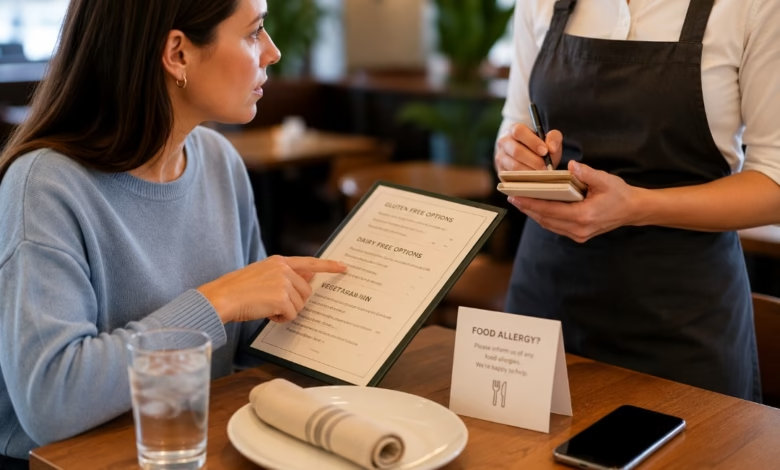
Food allergies can turn a normal restaurant order into a serious decision. A dish may look simple on the menu, but still contain wheat, milk, egg, soy, sesame, fish, shellfish, peanuts, tree nuts, broth, sauces, shared fryer contact, or ingredients that are not obvious from the name of the food.
If you are looking for food allergy questions restaurant guidance, the goal is not to make dining out stressful. The goal is to ask clear questions before ordering, understand what the restaurant can and cannot confirm, document important details for takeout or delivery, and avoid relying on vague answers like “it should be fine.”
This guide explains what to ask at restaurants, cafes, delis, bakeries, prepared-food counters and delivery apps. It also explains when packaged food labels may help, why restaurant foods can be different from packaged foods, how cross-contact can happen, and what to do if an allergy instruction is ignored.
Why food allergy questions matter before ordering
Food allergies require clear communication. A restaurant meal is different from eating food you prepared at home because you may not see the ingredients, labels, cooking surfaces, sauces, marinades, fryer oil, seasoning blends, toppings or preparation steps.
Even careful restaurants can make mistakes when staff are busy, menus change, suppliers change, recipes are adjusted, or allergy instructions are passed from a customer to a server to a kitchen worker. That is why the way you ask matters.
“Does this dish contain milk, butter, cream, cheese, or any dairy ingredient?” is stronger than “Is this dairy-free?” Specific questions reduce guessing.
Many restaurant allergy problems start with assumptions. A customer assumes a sauce is safe because it looks simple. A server assumes a dish is safe because the allergen is not visible. A menu says “vegetable soup,” but the broth may contain chicken or beef. A fried item looks gluten-free, but it may share oil with breaded food. A dessert may not mention nuts, but the kitchen may use almond flour, nut toppings or shared equipment.
The goal is not to interrogate restaurant staff. The goal is to make the risk visible before you order. If staff can answer clearly and confidently, that is a good sign. If they guess, avoid checking with the kitchen, or seem annoyed by basic allergy questions, choose safer food or a different place.
Restaurant food vs. packaged food labels
Packaged food and restaurant food are not the same experience for an allergy-conscious customer. Packaged foods often have ingredient lists and allergen labeling. Restaurant food is usually prepared to order or prepared in-house, and the information may come from the menu, staff knowledge, recipe cards, supplier labels or the kitchen.
This matters because a packaged frozen entrée may have a label you can read, but a restaurant dumpling, soup, sauce, pastry, salad dressing or cutlet may not come with a full ingredient list at the table. A deli tray may have a small label, but it may not describe every ingredient or cross-contact risk.
A restaurant menu is usually a sales description, not a complete ingredient statement. If an allergen matters to you, ask directly before ordering.
Some restaurants provide allergen menus, QR code guides, ingredient sheets or manager-reviewed allergy procedures. Others do not. A chain restaurant may have more standardized information than a small independent cafe, but even standardized menus can change. A small family restaurant may know its recipes well, but may not have written allergen procedures.
For packaged foods sold at a grocery store, cafe counter or deli refrigerator, read the full label when available. For unpackaged prepared foods, ask staff what ingredients are used and whether the item was prepared near your allergen.
The major allergens to ask about
In the United States, many allergy conversations focus on the major food allergens commonly identified in federal food-labeling discussions. For restaurant customers, the practical lesson is simple: know your allergen, ask about it by name, and do not assume it will be obvious from the dish description.
Common allergens and related ingredients to ask about include:
- Milk: butter, cream, cheese, sour cream, yogurt, milk powder, whey, creamy sauces.
- Egg: batter, mayonnaise, pasta, dumpling dough, baked goods, coatings, sauces.
- Wheat: flour, breadcrumbs, pasta, dumplings, breading, roux, soy sauce in some cases.
- Soy: soy sauce, marinades, oils, sauces, processed ingredients.
- Sesame: seeds, tahini, buns, sauces, spice blends, bakery toppings.
- Peanuts: sauces, desserts, oils, toppings, shared equipment.
- Tree nuts: almonds, walnuts, cashews, pistachios, hazelnuts, nut flours, pesto-style sauces.
- Fish: sauces, soups, broths, smoked fish, mixed seafood dishes.
- Crustacean shellfish: shrimp, crab, lobster, seafood stock, shared grills or fryers.
Some people also need to avoid gluten, sulfites, certain seeds, legumes, spices, food dyes, preservatives or ingredients tied to medical conditions. The restaurant may not be able to guarantee everything, but asking clearly helps you decide whether the risk is acceptable.
A plain-looking dish can still contain butter, flour, egg, broth, nut flour, sesame, soy sauce, fish sauce or shared fryer contact.
Questions to ask before choosing a restaurant
The best allergy conversation often happens before you arrive. If your allergy is serious, calling ahead can save time and reduce pressure. A busy Friday dinner rush is not the easiest moment for a server to investigate a complicated ingredient question.
Before choosing a restaurant, ask:
- Do you have an allergen menu or ingredient guide?
- Can a manager or kitchen lead answer allergy questions?
- Do you have a process for allergy orders?
- Can the kitchen change gloves, use clean utensils and avoid shared surfaces?
- Are fryers shared with breaded foods, seafood or other allergens?
- Are sauces, soups and dressings made in-house or from suppliers?
- Do menu items change often?
- Can you safely serve someone with this specific allergy?
The last question matters. A responsible restaurant may say, “We cannot safely guarantee that.” That answer can be disappointing, but it is better than false confidence. A restaurant that admits its limits may be safer than one that casually promises everything is fine without checking.
For serious allergies, call between rush periods. Staff may have more time to check ingredients, ask the kitchen and explain what is realistic.
If the restaurant sounds confused or dismissive on the phone, treat that as information. You do not have to argue. You can choose a place with clearer procedures.
Questions to ask the server before ordering
When you arrive, tell the server about the allergy before ordering, not after the food is already being prepared. Be direct and calm. Avoid vague statements like “I’m sensitive to dairy” if the issue is a serious allergy. Say what you need the kitchen to know.
Useful questions include:
- Can you please tell the kitchen this is an allergy, not a preference?
- Can you check whether this dish contains my allergen?
- Can you confirm the sauce, dressing, marinade and garnish?
- Is this item cooked on shared equipment?
- Is the fryer shared with breaded food, seafood or other allergens?
- Can the kitchen use clean utensils and a clean surface?
- Can the allergen be removed safely, or is it already in the recipe?
- Can a manager confirm the safest menu options?
Restaurants may treat “no cheese, please” differently from “I have a milk allergy.” Use the word allergy if that is the reason.
If the server says, “I think so,” ask if they can please check. A good server will not take that personally. If they seem uncertain, ask whether a manager can help. You are not being difficult; you are trying to avoid a preventable problem.
Questions the kitchen may need to answer
Some allergy questions cannot be answered from the dining room. The kitchen may need to check the recipe, packaging, prep station, fryer, sauce base, spice blend or supplier label.
Kitchen-level questions can include:
- Is the allergen part of the base recipe?
- Is the sauce made with butter, cream, flour, nuts, soy, sesame or seafood stock?
- Is the item marinated before service?
- Is the food breaded, dusted with flour or cooked with breadcrumbs?
- Are toppings added automatically before serving?
- Can the kitchen prepare the dish in a clean pan?
- Can clean utensils and gloves be used?
- Is the fryer shared with allergen-containing foods?
- Are ingredients pre-mixed in a way that cannot be changed?
- Can the kitchen safely make the dish without the allergen?
Sometimes the answer will be no. A soup may already contain cream. A dumpling dough may already contain egg. A sauce may already be made with wheat flour. A fryer may be shared with breaded seafood. In that case, removing the visible ingredient from the plate does not make the dish safe.
If the allergen is already in the sauce, dough, breading, broth, marinade or shared cooking process, simply removing the visible ingredient may not reduce the risk enough.
Cross-contact questions that people often forget
Cross-contact happens when an allergen touches food that would otherwise not contain it. This can happen through shared fryers, grills, knives, cutting boards, prep tables, tongs, gloves, storage bins, sauce spoons, bakery trays or steam-table utensils.
Cross-contact questions are especially important when eating fried foods, bakery items, deli foods, buffet-style foods, ice cream, salads, soups, sauces and prepared foods.
Ask:
- Is this cooked in a shared fryer?
- Is the grill shared with seafood, breaded foods or dairy ingredients?
- Are clean utensils used for allergy orders?
- Are cutting boards and prep surfaces cleaned between orders?
- Are bakery items stored together?
- Are toppings handled with shared scoops or tongs?
- Are sauces ladled with shared spoons?
- Are salads assembled near nuts, cheese, croutons or sesame toppings?
- Are deli items sliced on shared equipment?
- Can the kitchen prepare this separately?
A dish can be made without your allergen as an ingredient and still be risky if it is cooked or handled with shared equipment.
Restaurants vary in how well they can manage cross-contact. Some have strong procedures. Others do not. A restaurant that cannot prevent cross-contact should say so clearly.
Delis, bakeries and prepared-food counters
Restaurants are not the only places where allergy questions matter. Delis, bakeries, cafes, grocery hot bars, prepared-food counters and specialty stores can be more complicated because items may be made in batches, displayed near each other, sliced on shared equipment or packaged with limited information.
At delis and prepared-food counters, ask:
- Is there a full ingredient list for this item?
- Was it made in-house or supplied by another company?
- Does it contain wheat, milk, egg, soy, sesame, fish, shellfish, peanuts or tree nuts?
- Was it prepared near other allergen-containing foods?
- Are serving spoons or tongs shared between items?
- Is the slicer used for multiple foods?
- Are bakery trays shared?
- Is the item packaged with a label?
- Can staff check the package or recipe before answering?
Bakeries need special caution. Flour, nuts, eggs, dairy, sesame and shared trays can be common. Even if one pastry does not contain nuts as an ingredient, it may be displayed next to nut pastries or handled with shared tools.
Food behind glass can look separated, but shared utensils, trays, slicers and prep surfaces can still create cross-contact risk.
If the food is packaged, read the label carefully. If the label is missing, incomplete or in a language you do not understand, ask for help before buying. If staff cannot identify the ingredients, choose another item.
Takeout and delivery allergy precautions
Takeout and delivery add another layer of risk because you are not speaking to the kitchen at the moment the food is handed to you. Allergy instructions may be entered through a small note field, missed by the restaurant, ignored by a busy kitchen, or separated from the printed ticket.
Before placing a takeout or delivery order, consider these steps:
If the allergy is serious, call the restaurant before placing the order and ask whether they can safely handle it.
Use the order notes clearly: “Milk allergy. Please confirm no butter, cream, cheese or dairy in this item.” Do not use vague shorthand.
Complex dishes with sauces, breading, mixed fillings, toppings and shared fryers can be harder to verify.
Look at labels, receipts, containers and visible toppings. If something looks wrong, stop and contact the restaurant before eating.
For delivery problems involving missing items, ignored instructions, wrong dishes or refund requests, read our guide to food delivery refund rights. Allergy-related delivery problems should be documented quickly, especially if the food could be unsafe for you.
For serious allergies, do not rely only on a short app note. Call the restaurant when possible and confirm that the kitchen can handle the request.
What to document if something goes wrong
If a restaurant ignores an allergy instruction or you receive food that may contain your allergen, document the issue before throwing anything away. This matters for customer service, refunds, health concerns, complaints and your own records.
Save:
- receipt or order confirmation;
- menu description;
- allergy note or written instruction;
- photos of the food as received;
- photos of labels, packaging or container notes;
- messages with the restaurant or delivery platform;
- name of the restaurant location;
- date and time of the order;
- what staff said about ingredients;
- symptoms and timing, if a reaction occurred;
- medical records, if medical care was needed.
If you experience symptoms of a serious allergic reaction, seek medical help immediately. Documentation can wait until you are safe. For less urgent situations, take photos, save the food if appropriate, and contact the restaurant or platform as soon as possible.
Write down what you ordered, what allergy instruction you gave, what arrived, when you noticed the issue, who you contacted and what response you received.
Consumer-rights angle: refunds, complaints and safety concerns
An allergy-related restaurant problem may involve several issues at once: food safety, customer service, refund requests, billing disputes, health concerns and restaurant procedures. The right next step depends on what happened.
Possible next steps include:
- asking the restaurant to remake the dish safely;
- requesting a refund for an unsafe or incorrect item;
- contacting delivery app support if ordered through a platform;
- saving written proof of allergy instructions;
- reporting a serious food safety concern to a local health department;
- contacting a payment provider for a documented billing dispute;
- seeking medical help if symptoms occur;
- speaking with a qualified attorney if there is serious harm or a legal dispute.
For general restaurant overcharges, refunds and billing issues, our guide to restaurant consumer rights explains how to check bills, save receipts, dispute charges and complain when a restaurant will not correct a documented problem.
If a dish was wrong but no reaction occurred, say that. If a reaction occurred and medical care was needed, document that carefully. Accurate facts matter.
Many allergy mistakes are resolved through customer service. Serious reactions, repeated unsafe practices or ignored written allergy instructions may require more formal action.
Simple scripts you can use
Clear language helps. You do not need to sound legal or dramatic. You need staff to understand the exact allergy and the exact question.
Before choosing a restaurant
Hello, I have a serious allergy to [allergen]. Before I make a reservation, can your kitchen safely prepare a meal without [allergen] and avoid cross-contact? Is there a manager or kitchen lead who can confirm?
At the table
I have an allergy to [allergen]. Could you please tell the kitchen this is an allergy, not a preference, and confirm whether [dish] contains [allergen] or is cooked with shared equipment?
For takeout or delivery
I have a [allergen] allergy. Please confirm that this order does not contain [specific ingredients] and is not prepared with shared [fryer/pan/surface] if possible. If that cannot be done safely, please let me know before preparing the order.
If the order appears unsafe
Hello, I ordered [item] and clearly noted a [allergen] allergy. The food appears to contain or may have been prepared with [allergen]. I have not eaten it. I attached the receipt, allergy note and photos. Please review this order for a refund or safe replacement.
Use your own words, but keep the message short. The more serious the allergy, the more important it is to be direct.
Useful sources
For food allergy, labeling, dining-out and food safety information, check current official sources. Restaurant practices, food labeling rules, state requirements and safety procedures may vary.
This article is for general informational purposes only and is not legal advice, medical advice or individualized allergy guidance. Food allergy risks, restaurant practices, labeling rules, cross-contact risks and consumer options can vary by restaurant, state, food type, packaging, preparation method and individual medical history. If you have a serious allergy, medical condition, symptoms of a reaction, a food safety concern or a legal dispute, consider contacting a qualified medical professional, local health department, appropriate agency or qualified attorney.
Questions and answers
What food allergy questions should I ask at a restaurant?
Ask whether the dish contains your allergen, whether sauces or marinades include it, whether the fryer or grill is shared, whether clean utensils can be used, and whether a manager or kitchen lead can confirm the answer before you order.
Should I tell the server my allergy is serious?
Yes. If it is a true allergy, say that clearly. Restaurants may treat a preference differently from an allergy. Use direct language such as “I have a milk allergy” or “I have a peanut allergy,” then ask the server to confirm with the kitchen.
Can a restaurant guarantee food is allergen-free?
Some restaurants may be able to follow allergy procedures, but many cannot guarantee that food is completely allergen-free because of shared kitchens, equipment, suppliers and cross-contact risk. If staff cannot answer clearly, choose a safer option.
What is cross-contact in a restaurant?
Cross-contact happens when an allergen touches food that would otherwise not contain it. This can happen through shared fryers, grills, knives, cutting boards, gloves, tongs, sauce spoons, bakery trays or prep surfaces.
Are restaurant menus required to list all allergens?
Restaurant allergen disclosure rules can vary, and a menu is usually not the same as a full packaged-food label. If an allergen matters to you, ask directly about ingredients, sauces, preparation and shared equipment before ordering.
What should I do if my delivery order ignores an allergy note?
Do not eat the food if you believe it may be unsafe. Save the receipt, allergy note, order confirmation, photos and messages. Contact the restaurant or delivery platform quickly and ask for a safe replacement or refund if appropriate.
What foods are risky for hidden allergens?
Sauces, soups, fried foods, dumplings, cutlets, baked goods, desserts, marinades, dressings, deli salads and prepared foods can contain hidden allergens or cross-contact risks. Ask about ingredients and preparation before ordering.
Should I call a restaurant before going if I have a severe allergy?
Calling ahead is often wise. Ask whether the restaurant can safely handle your specific allergy, whether a manager can help, and whether the kitchen can avoid cross-contact. If the answer is vague, choose another place.
What should I document after an allergy-related restaurant problem?
Save the receipt, menu description, allergy instruction, photos of the food, packaging, messages, restaurant location, date, time and any medical records if a reaction occurred. A clear timeline helps if you need a refund, complaint or further help.
Is this article medical or legal advice?
No. This guide provides general information about food allergy questions, restaurant ordering, documentation and consumer concerns. It is not medical advice or legal advice.
у своєму регіоні або по всьому світу
locally or worldwide