
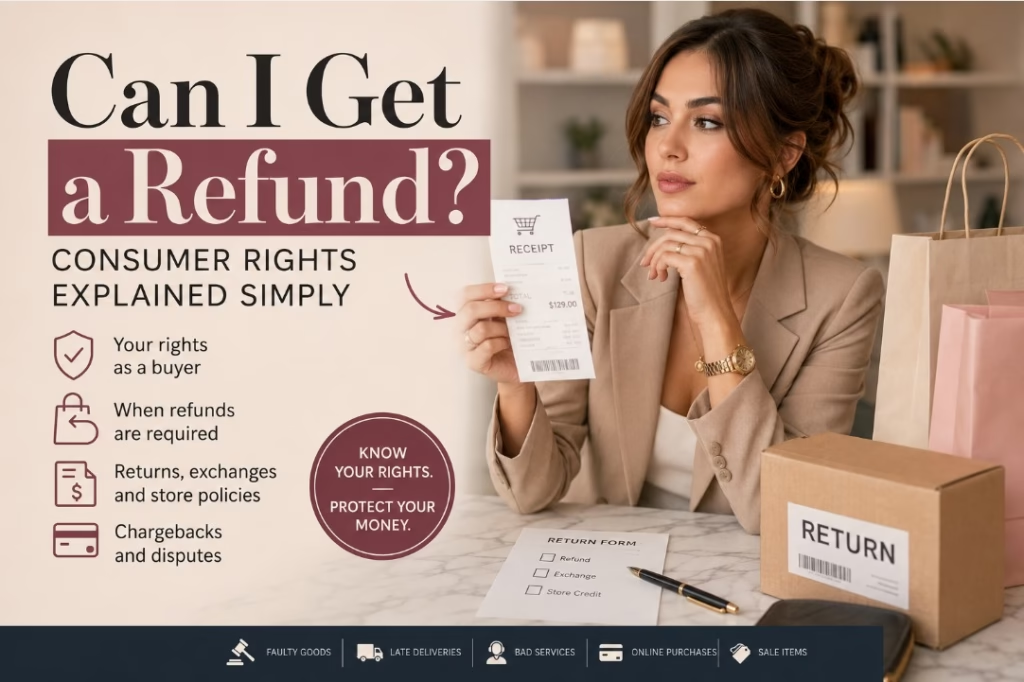
Can I Get a Refund? Consumer Rights Explained Simply

Can I get a refund? Sometimes yes. Sometimes no. And sometimes the answer is, “The store is hoping you do not know the difference.”
A refund is usually strongest when something is faulty, not as described, never arrives, arrives far too late, a service is not done with reasonable care, or the seller promised something they did not deliver. A refund is weaker when you simply changed your mind, bought the wrong size, missed the return window, or ignored a clear final-sale policy. That does not mean you have no options. It means you need to ask the right way and understand which kind of refund request you are making.
This guide explains refund rights in plain English. It is not legal advice for one specific country, state, province, or purchase. Consumer law changes by location, and refund rules can depend on where you bought the item, how you bought it, what went wrong, the seller’s policy, and whether the product or service is covered by a special rule. But the practical logic is often the same: identify the problem, gather proof, ask clearly, escalate calmly, and do not let a vague “store policy” scare you away from rights the law may protect.
Article contents
Use this section as your quick refund map. Jump to the situation that matches your purchase, or read from the beginning if you are not sure whether you have a legal right, a policy right, or just a polite request.
The first refund question is not “Do they allow returns?”
The first question is: why do you want the refund?
That sounds simple, but it changes everything. A refund request because “I changed my mind” is very different from a refund request because “the product is defective,” “the item never arrived,” “the seller shipped the wrong thing,” or “the service was not performed properly.” A store’s return policy matters more when you changed your mind. Consumer protection law matters more when the seller failed to deliver what was promised.
So before you argue with customer service, put your refund request into one of these categories. It will make your message clearer and your case stronger.
Policy refund: the seller offers returns as a business choice, often for unused items within a certain number of days. This is common for clothes, shoes, home goods, and many retail purchases.
Rights-based refund: the problem is not just preference. Something is faulty, misrepresented, missing, late, unsafe, not supplied, or not performed as promised.
A store can usually set rules for change-of-mind returns, such as deadlines, tags, packaging, and receipt requirements. But a store policy should not be used to mislead you about legal rights that apply when goods are faulty, orders are not delivered, or services are not performed properly.
Simple rule: if the seller did what they promised and you just regret the purchase, the store policy may control. If the seller did not do what they promised, your consumer rights may be stronger than the return policy.
Refund, return, exchange, repair, credit: do not let the words blur together
When a seller says, “We can only offer store credit,” that may be fine in some situations and not fine in others. The words matter.
A refund means money goes back to you, usually to the original payment method. A return means you give the item back. An exchange means you receive another item instead. A repair means the seller fixes the problem. A replacement means you receive the same or comparable product again. Store credit means you do not get your money back; you get value to spend with the same seller later.
Those options are not equal. If you simply changed your mind and the store clearly allows only store credit, that may be the policy. But if the product is defective or the seller broke a clear promise, you may not want to accept store credit too quickly. Store credit keeps your money with the same business that already caused the problem.
| Option | What it means | When it may make sense |
|---|---|---|
| Refund | Money is returned to your payment method or sometimes another agreed method. | Best when the item is faulty, missing, undelivered, cancelled, or the seller cannot provide what was promised. |
| Exchange | You swap the item for another size, color, model, or product. | Useful when the item is basically fine but not right for you. |
| Repair | The seller or manufacturer tries to fix the defect. | Often reasonable for appliances, electronics, furniture, vehicles, and higher-value goods. |
| Replacement | You receive a working version of the same or similar item. | Good when the product arrived damaged or defective but you still want it. |
| Store credit | You can spend the amount with that seller later. | More acceptable for change-of-mind returns; less ideal when the seller caused the problem. |
If you changed your mind, your rights depend heavily on how you bought it
This is the part people often misunderstand. In many places, there is no universal refund right just because you regret a purchase. A store may choose to accept returns because it wants happy customers, but that is not the same as a legal right in every situation.
If you bought an item in a physical store, inspected it, paid for it, and the item is not faulty, your ability to return it may depend mostly on the store’s policy. That policy may require a receipt, original packaging, tags attached, no signs of use, and a deadline such as 14, 30, 60, or 90 days.
Online purchases can be different. Some places give consumers a cancellation or withdrawal period for distance sales, but the details depend on location and product type. The European Union, for example, gives many consumers a 14-day cooling-off period for online, phone, and doorstep purchases, but exclusions can apply. The United States does not have one blanket federal rule that lets you return every online purchase simply because you changed your mind, though specific rules may apply to certain situations.
Stronger change-of-mind situation: the seller’s policy clearly says returns are allowed, or your local law gives a cooling-off period for that type of purchase.
Weaker change-of-mind situation: you bought in store, the item is not defective, the policy says final sale, and no special cooling-off rule applies.
Changed-mind returns are still worth asking about. Be polite, fast, and realistic. If the law does not give you a refund, the seller may still offer an exchange or store credit. That is not always perfect, but it can be better than keeping something you will never use.
Faulty, broken, unsafe, or poor-quality products are a different conversation
A faulty product is not the same as buyer’s remorse. If an item breaks immediately, does not work, is unsafe, has a manufacturing defect, or fails to meet basic quality expectations, you may have rights beyond the seller’s ordinary return policy.
Do not let customer service turn a defect into a preference issue. “I do not like the color” is preference. “The kettle sparks when plugged in” is not preference. “The jacket is smaller than I expected” may be fit. “The zipper broke the first time I wore it” is a quality problem. “I changed my mind about the headphones” is one thing. “The headphones never charge” is another.
Your remedy may be a refund, repair, replacement, price reduction, or another solution depending on your location, the product, the time since purchase, and whether the seller gets a chance to fix the problem. But the key is to describe the defect clearly and quickly.
For electrical, food, children’s products, medical items, or anything that could cause harm, do not keep testing it casually. Safety matters more than proving a point.
Take photos, videos, screenshots, error messages, serial numbers, labels, packaging, and the receipt. Show the problem clearly.
Even if you speak by phone, send a follow-up email or chat message so there is a record of what you asked for and when.
Say whether you want a refund, replacement, repair, or cancellation. Do not make the seller guess.
Timing matters. The sooner you report a fault, the easier it is to connect the problem to the purchase rather than later misuse or ordinary wear and tear.
If the item is not as described, focus on the promise
“Not as described” means the seller represented the product one way and delivered something materially different. This can include wrong size, wrong model, wrong material, missing accessories, fake branding, incorrect features, inaccurate condition, misleading photos, or a product that does not match the listing.
The strongest argument is not “I am disappointed.” The strongest argument is “Here is what the seller promised, and here is what arrived.”
For example, if a listing says a coat is wool and it arrives as polyester, that is not simply taste. If a phone is advertised as unlocked and arrives locked, that is a mismatch. If a “new” item arrives used or damaged, that matters. If a dining table listing says solid wood and the product is veneer or particleboard, describe the difference and attach proof.
Make it specific: quote the product page, screenshot the listing, save the order confirmation, photograph what arrived, and explain the gap in one clear paragraph.
Do not write a dramatic message first. Write a precise one. Sellers respond better when the issue is easy to verify. Payment companies and consumer agencies also understand a precise paper trail better than a long emotional essay.
Online orders: late delivery, missing packages, and items that never ship
Online refund rights often depend on shipping promises. If a seller promised delivery by a certain date and cannot meet it, you may have options to cancel or request a refund. In the United States, the FTC’s Mail, Internet, or Telephone Order Merchandise Rule generally requires sellers to have a reasonable basis for shipping when promised, or within 30 days if no shipping time is stated, and to seek your consent for a delay or provide a refund in covered situations.
In plain English: a seller should not take your money, fail to ship, keep delaying, and leave you with nothing but automated apology emails.
Missing packages are trickier. A carrier may mark an item delivered when you never received it. The seller may tell you to contact the carrier. The carrier may tell you to contact the seller. This is where documentation matters.
If it never shipped: ask the seller to cancel and refund. Include your order number, order date, promised shipping date, and any delay notices.
If it says delivered but is missing: check delivery photos, address details, neighbors, building desk, parcel lockers, and carrier tracking. Then contact the seller in writing.
Do not wait too long. Sellers, carriers, and payment providers often have deadlines for claims and disputes. The longer you wait, the more the situation turns into “maybe something happened later,” even if you genuinely never received the item.
Refunds for services are about the work, not your mood after the appointment
Services can include repairs, cleaning, beauty appointments, home improvement, subscriptions, coaching, design work, event services, travel-related services, and many other things. A service refund usually depends on what was promised, what was delivered, and whether the provider used reasonable care and skill.
If the service was done poorly, unfinished, not performed, performed late in a way that caused real harm, or very different from what was agreed, you may have a stronger case. But if the provider did the agreed work properly and you simply do not love the result, the refund may be harder.
That difference can be frustrating. A haircut you dislike is emotionally serious. But a refund case is stronger if you can show the stylist ignored the agreed length, damaged your hair, failed to provide the booked service, or charged for something not done. A home repair refund is stronger if the work was defective, incomplete, unsafe, or contrary to the written estimate.
| Service issue | Refund strength | What to collect |
|---|---|---|
| Service never performed | Often stronger | Booking confirmation, payment proof, cancellation messages, no-show evidence. |
| Service unfinished | Can be strong | Contract, scope of work, photos, timeline, messages, invoice details. |
| Poor quality work | Depends on proof | Before/after photos, expert opinion if needed, written standards, repair estimates. |
| You disliked the style | Usually weaker | Messages showing what was requested, photos, consultation notes. |
With services, ask for a practical remedy. That might be a correction, partial refund, full refund, re-performance, cancellation of remaining sessions, or a credit. The right answer depends on how badly the service failed and whether it can be fixed.
Digital products, apps, downloads, and subscriptions need quick action
Digital purchases can be confusing because you may not have a physical item to return. Apps, downloads, streaming subscriptions, digital courses, software, templates, ebooks, games, and online memberships often have their own refund rules, platform rules, and local consumer laws.
A digital refund is stronger when the product does not work, access is never provided, the subscription renews despite cancellation, the purchase was unauthorized, or the seller misrepresented the digital content. It is weaker when you downloaded the file, used the content, and simply decided you no longer want it, unless a specific policy or local law gives you a cancellation right.
Subscriptions are especially time-sensitive. Cancel in the account settings, take screenshots, save confirmation emails, and check whether the cancellation applies immediately or at the end of the billing period. If you are charged after cancellation, collect proof of the cancellation date and contact the seller or platform quickly.
Good proof: screenshots of the cancellation page, confirmation emails, billing dates, app store receipts, failed access messages, and support chat transcripts.
Common trap: thinking uninstalling an app cancels the subscription. It usually does not. Cancel through the platform, account page, or billing provider.
Sale items, clearance, and “final sale” signs do not erase every right
Sale items create a lot of confusion. A store can often set stricter change-of-mind rules for clearance or final-sale items. That may mean no return because the color was wrong, the fit was bad, or you found a better price later.
But a sale sign should not be used to hide a real defect unless the defect was clearly disclosed before you bought it. If a jacket is reduced because it is last season, it should still generally be a jacket that functions as described. If a lamp is marked final sale but arrives broken, “final sale” is not magic dust that makes the broken lamp your personal burden.
The key is whether the problem was disclosed. If a tag says “small scratch on back panel” and you buy it anyway, that scratch will be hard to use as a refund reason. If the product has a hidden defect that was not disclosed, your argument is stronger.
Practical move: when buying sale, clearance, outlet, open-box, or final-sale goods, photograph the tag, receipt, and any disclosed defect before leaving the store.
Proof makes refund requests calmer and stronger
You do not need to sound aggressive to be taken seriously. You need proof. A calm message with receipts, dates, screenshots, photos, and a clear remedy often works better than a furious message with no structure.
Keep everything connected to the purchase: order confirmation, receipt, invoice, tracking, product page screenshots, warranty card, serial number, customer service chat, photos of the defect, videos showing the problem, cancellation confirmation, and notes from phone calls.
Phone calls can help, but written proof protects you. After a call, send a short follow-up: “Thank you for speaking with me today. As discussed, I am requesting a refund because…” That creates a record without sounding dramatic.
How to ask for a refund clearly without sounding chaotic
The best refund request is short, specific, and hard to misunderstand. Customer service workers see vague messages all day. Make yours easy to process.
Include the order number, purchase date, product or service name, what went wrong, what proof you attached, and what remedy you want. Do not start with a legal threat. Start with clarity. You can escalate later if needed.
A refund message should answer four questions: What did you buy? What went wrong? What proof do you have? What do you want the seller to do now?
Subject: Refund request for order #[order number]
Opening: I purchased [item/service] on [date]. I am requesting a refund because [clear reason].
Proof: I have attached [photos/screenshots/receipt/tracking/cancellation confirmation] showing the issue.
Request: Please refund [amount] to my original payment method within [reasonable time], or explain in writing why you believe a refund is not available.
That last sentence matters. It asks for a decision in writing. Written answers are easier to use if you need to escalate through a payment provider, consumer agency, marketplace, platform, or small claims process.
What to do if the seller says no
A refund denial is not always the end. It may be a real answer, or it may be the first answer from a person who is trained to say no quickly. Your next move depends on why they refused.
Ask for the reason in writing. Then compare it to the facts. Did they say the return window passed? Check whether your issue is actually a defect, late delivery, or misrepresentation rather than a simple return. Did they say “final sale”? Check whether the product was faulty or not as described. Did they offer repair instead of refund? That may be reasonable in some cases, but not always.
Keep it simple: “Please confirm the reason for refusing the refund and identify the policy or legal basis you are relying on.”
Ask for a supervisor, complaints team, billing department, or written dispute process. Stay calm and attach the same proof again.
If you bought through a marketplace, app store, booking platform, or payment service, check its buyer protection process.
Depending on your location and purchase, that may include a card dispute, consumer protection agency, ombudsman, regulator, mediation, or small claims court.
Chargebacks and payment disputes are not the first move, but they matter
A chargeback or payment dispute asks your card issuer or payment provider to reverse a charge. It can be useful when a seller refuses to help, an item never arrives, a product is not as described, a charge is unauthorized, or a subscription continues after cancellation.
But do not treat chargebacks like a casual return button. Payment disputes have deadlines, rules, and evidence requirements. Filing a weak or misleading dispute can fail, and in some cases it can create account problems with the seller or platform.
Before disputing, usually try to resolve the issue with the seller unless the charge is clearly unauthorized or fraudulent. Keep proof that you contacted the seller, what they said, and why their response did not solve the problem.
Dispute may help: no delivery, unauthorized charge, duplicate charge, cancelled subscription still billed, seller refuses to refund a clear failure.
Dispute may be weak: you changed your mind, ignored the return policy, used the service, or cannot show what the seller did wrong.
Scams, fake stores, and suspicious sellers need fast action
If the seller disappears, the website vanishes, tracking is fake, the product never ships, or the charge looks unauthorized, treat it differently from an ordinary return. A scam refund is often about speed.
Contact your bank, card issuer, or payment provider quickly. Save the website URL, screenshots, receipt, order confirmation, emails, tracking number, seller address, and any messages. Do not keep emailing a fake seller for weeks while dispute deadlines pass.
Be especially careful with sellers that only accept risky payment methods, pressure you to pay outside a platform, use copied product photos, offer prices that are absurdly low, hide contact information, or have no real return address.
Red flag: a seller that refuses normal payment channels, demands friends-and-family payment, or asks you to cancel a marketplace dispute may be trying to remove your protection.
Refund mistakes that weaken your case
Some refund requests fail because the right was weak. Others fail because the consumer accidentally made the situation harder to prove.
Do not throw away packaging too early if the item is defective or not as described. Do not wait months to report a problem. Do not keep using an unsafe product. Do not send angry messages that hide the actual facts. Do not accept store credit if you believe you are entitled to money back and you are not comfortable with credit. Do not return an item without tracking if the seller may later claim they never received it.
Bad move: “This is ridiculous. I want my money back now.”
Better move: “The item arrived on March 4. It does not power on. I attached a video and receipt. Please refund the purchase price to my original payment method.”
Clear beats loud. Proof beats panic. A calm timeline beats ten scattered messages.
A simple refund decision map
Use this quick map before you contact the seller.
| Your situation | Refund strength | Best first move |
|---|---|---|
| Changed your mind | Depends on store policy and local cooling-off rules | Check the return policy, act quickly, keep packaging, ask politely. |
| Product is faulty | Often stronger | Document the fault and ask for refund, repair, or replacement. |
| Item not as described | Often stronger | Compare the listing to what arrived and attach screenshots/photos. |
| Order never shipped | Strong if seller misses promised timing or keeps delaying | Request cancellation and refund in writing. |
| Service was poor | Depends on proof and agreement | Point to the contract, estimate, promised result, photos, or incomplete work. |
| Subscription billed after cancellation | Can be strong with proof | Send cancellation confirmation and billing record; then escalate if needed. |
| Final sale item defective | May still be strong if defect was not disclosed | Explain that the issue is a defect, not a change-of-mind return. |
Official sources
Refund rules vary by location and purchase type. Check current official sources before making decisions, especially for legal deadlines, cancellation periods, and dispute procedures.
- Federal Trade Commission: Buyer’s Remorse and the Cooling-Off Rule
- Federal Trade Commission: Mail, Internet, or Telephone Order Merchandise Rule
- eCFR: 16 CFR Part 435 Mail, Internet, or Telephone Order Merchandise
- Your Europe: Returns and the right of withdrawal
- European Commission: Consumer Rights Directive
- GOV.UK: Accepting returns and giving refunds
- GOV.UK: Consumer protection and rights
FAQ: Can I Get a Refund?
Can I always get a refund if I changed my mind?
Not always. If the product is not faulty and you simply changed your mind, your refund may depend on the store’s return policy or any cooling-off rights that apply where you live. Online, phone, or doorstep purchases may have extra rules in some places, but there is no single worldwide refund rule for buyer’s remorse.
Can a store refuse a refund and offer store credit instead?
Sometimes yes, especially for change-of-mind returns if the policy clearly says store credit only. But if the product is faulty, not as described, never delivered, or the seller failed to provide what was promised, you may want to challenge store credit and ask for a real refund.
What should I do first if a product is faulty?
Stop using it if it may be unsafe, take photos or video of the problem, keep the receipt and packaging if possible, and contact the seller in writing. Say exactly what is wrong and whether you want a refund, replacement, or repair.
Can I get a refund for a sale or clearance item?
A store can often limit change-of-mind returns on sale or clearance items. However, a discount does not automatically remove your rights if the item is faulty or not as described, unless the defect was clearly disclosed before you bought it.
What if my online order never arrived?
Check the tracking, delivery address, delivery photo, parcel locker, building desk, and neighbors first. Then contact the seller in writing with your order number and tracking details. If the seller cannot prove proper delivery or keeps delaying shipment, you may be able to ask for a refund or dispute the charge through your payment provider.
How long do refunds usually take?
Refund timing depends on the seller, payment method, platform, and law in your location. Some refunds appear in a few business days, while others take longer. Ask the seller to confirm the refund date, amount, and payment method in writing.
Can I get a refund for a bad service?
It depends on what was promised and what went wrong. A refund is more likely if the service was not performed, was unfinished, was done without reasonable care, or was clearly different from the agreement. If you simply dislike the result, the case may be harder unless you can show the provider ignored the agreed instructions.
Should I accept a repair instead of a refund?
A repair can be reasonable for some products, especially higher-value items. But if the item is new, seriously defective, unsafe, repeatedly failing, or the repair would not solve the problem, a refund or replacement may be more appropriate. Check your local rules before accepting a remedy you do not want.
When should I file a chargeback or payment dispute?
Consider a chargeback or payment dispute when the seller refuses to help, the item never arrives, the charge was unauthorized, the product is not as described, or you are billed after cancellation. Keep proof that you contacted the seller first, unless the charge was clearly fraudulent or unauthorized.
What proof helps most when asking for a refund?
The strongest proof usually includes your receipt or order number, product listing screenshot, photos or video of the problem, tracking information, cancellation confirmation, warranty details, and written messages with the seller. Keep everything organized by date.
у своєму регіоні або по всьому світу
locally or worldwide