
Can AI Give Legal Advice? What You Should Know Before Trusting It
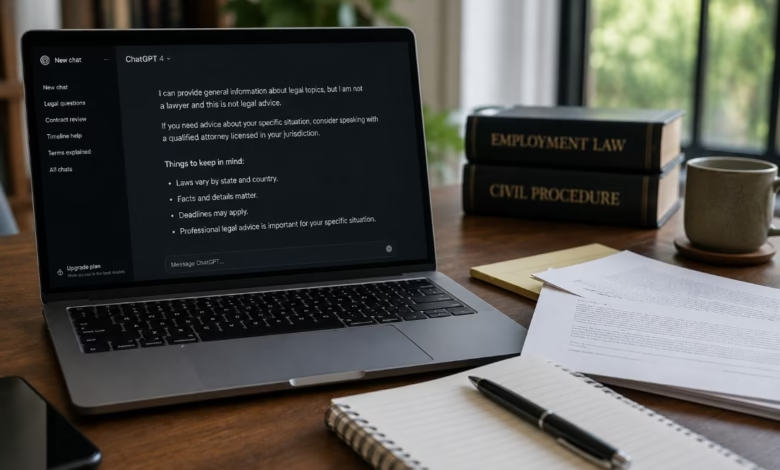
Artificial intelligence can produce a polished answer to a legal question within seconds. It can explain unfamiliar terms, summarize a document, suggest questions for an attorney and help someone understand the general shape of a legal problem. That convenience can be valuable, especially when legal services feel expensive or difficult to access.
But a confident AI response is not necessarily a correct legal answer. The system may rely on incomplete information, misunderstand your state, invent a court decision, overlook a filing deadline or present a general rule as though it applies universally. It also may not clearly recognize when a seemingly simple question involves serious financial, immigration, family, employment or criminal consequences.
AI can provide general legal information, but it should not be treated as a substitute for advice from a qualified attorney who understands your documents, jurisdiction, deadlines and individual circumstances.
Can AI Actually Give Legal Advice?
AI can generate an answer that looks and sounds like legal advice. It may tell you what a law appears to require, outline possible claims, suggest language for a letter or explain what usually happens in a legal process. That does not mean the system has formed an attorney-client relationship with you or assumed professional responsibility for the answer.
A licensed attorney is expected to identify the relevant jurisdiction, investigate material facts, understand the client’s goals, evaluate conflicting evidence, recognize ethical duties and consider the consequences of different strategies. A general-purpose AI system normally does none of those things in the same accountable way.
Even when an AI answer contains a correct legal rule, the application of that rule may be wrong. One missing fact can change the outcome. The date of an incident, the place where it occurred, the language of a contract, the type of employer, the identity of the parties or a previous court order may be decisive.
AI can help you learn about a legal topic and prepare for the next step. It cannot reliably determine your legal rights from a short prompt, guarantee that a rule is current or protect you from the consequences of acting on an incorrect answer.
Some AI products are designed specifically for legal research, document management or lawyer-supervised work. Those tools may have access to legal databases and additional verification systems. Even then, the output normally requires review by a trained professional. A specialized legal platform is not automatically correct merely because it uses legal sources.
Legal Information and Legal Advice Are Not the Same
The distinction between legal information and legal advice is important because the two can sound similar.
Legal information explains the general rules
General legal information might describe:
- what a security deposit is;
- how a small claims case commonly begins;
- the general purpose of a non-compete agreement;
- what discrimination or retaliation can mean;
- which government agency handles a certain type of complaint;
- what documents people commonly bring to a legal consultation.
This information can help a reader understand terminology and identify possible next steps. It does not determine what a particular person should do.
Legal advice applies law to an individual situation
Legal advice usually requires an assessment of specific facts. For example:
- Does this lease allow the landlord to keep the deposit?
- Was this employee terminated for an unlawful reason?
- Should this settlement agreement be signed?
- Is this person eligible for a particular immigration benefit?
- Has the deadline for filing a claim expired?
- Would sending this message harm the person’s position?
A trustworthy answer may require documents, dates, interviews, research into current law and knowledge of local procedure. An AI system may offer an immediate conclusion without obtaining all of that information.
A general explanation can still be useful. The danger begins when a reader treats a broad explanation as a personalized conclusion and makes an irreversible decision based on it.
What AI Can Reasonably Help With
AI is not useless in a legal context. Used carefully, it can make legal information easier to understand and help someone prepare for a conversation with a lawyer, court clerk, government agency or other qualified professional.
Explaining unfamiliar legal terms
You may ask AI to explain words such as indemnification, arbitration, negligence, retaliation, jurisdiction or statute of limitations in plain language. This can provide a starting point before you read an official source or speak with an attorney.
The explanation should still be checked because the same term can carry different meanings in different laws, contracts or jurisdictions.
Organizing a timeline
A person dealing with a workplace dispute, landlord problem, accident or contract disagreement may have dozens of emails, calls and events to remember. AI can help turn rough notes into a chronological list.
A useful timeline may contain:
- the exact date of each event;
- the people involved;
- what was said or done;
- the related email, message, invoice or document;
- what happened afterward;
- any deadlines or scheduled hearings.
Do not include confidential or highly sensitive information unless you understand how the particular tool stores and uses submitted data.
Preparing questions for a lawyer
AI can suggest a list of questions for an initial consultation. For example, you might ask it to create questions about legal fees, expected deadlines, available remedies, evidence, settlement options and possible risks.
This is one of the safer uses because the AI is helping you prepare rather than making the final decision.
Creating a document checklist
You can use AI to generate a preliminary checklist of materials commonly associated with a type of dispute. A workplace checklist might mention pay records, policies, performance evaluations and messages. A tenant checklist might mention the lease, repair requests, photographs and payment records.
The checklist should be treated as a starting point. A lawyer may need additional documents that the system did not identify.
Turning complicated text into plain language
AI may help summarize a long policy, contract clause or government instruction. A summary can make the document easier to navigate, but it should not replace the original. Important exceptions, definitions and obligations are often found in language that a short summary leaves out.
Locating the type of official source you need
AI can suggest that a wage issue may involve a labor department, a discrimination complaint may involve an equal employment agency or a consumer problem may belong with a state attorney general. You should then visit the actual official website and confirm the agency’s authority, procedures and deadlines.
Use AI as a preparation assistant, not as the final decision-maker. Let it help you identify vocabulary, questions, records and official sources. Do not let it make an unverified decision that could affect your legal status, money, family, employment or freedom.
Why AI Legal Answers Can Be Wrong
Generative AI systems produce responses by identifying patterns in data and predicting useful language. They do not reason, investigate and assume responsibility in the same manner as a lawyer. A response may sound authoritative even when the system lacks enough information to answer correctly.
Several different problems can occur.
The answer may be based on missing facts
Legal questions rarely include every relevant fact in the first sentence. A user may ask, “Can my employer fire me for this?” without explaining:
- whether the employment is public or private;
- whether a union agreement applies;
- which state governs the employment;
- whether the employee reported discrimination or safety concerns;
- whether the employee requested protected leave;
- whether there is an employment contract;
- what reason the employer gave;
- how much time has passed.
An AI response may assume answers to those questions rather than clearly identifying what is missing.
The law may have changed
Laws, regulations, agency guidance and court decisions change. A model may rely on outdated information or fail to distinguish between a proposed bill and an enacted law.
Even an AI system with internet access may retrieve an old agency page, a superseded regulation or a summary that does not reflect the current legal position. The publication date and effective date both matter.
The system may oversimplify exceptions
Legal rules often contain exceptions, exemptions, definitions and procedural conditions. A system may accurately state the general rule while missing the exception that controls your case.
For example, a law may apply only to employers of a certain size, contracts entered after a particular date, properties in a specific city or claims filed within a short period.
The response may confuse jurisdictions
An answer based on federal law may overlook a stronger state protection. A description of one state’s procedure may be presented as a nationwide rule. Information from another country may appear in an answer to a U.S. question if the prompt is vague.
The language may create false confidence
People naturally associate clear language with expertise. AI can produce a structured explanation with headings, examples and an apparently definite conclusion. The professional appearance of the answer does not verify its accuracy.
Invented Cases, Laws and Quotations
One of the most serious risks is the generation of nonexistent or materially inaccurate legal authority. This is commonly described as an AI hallucination.
An AI-generated response may:
- invent the name of a court case;
- provide a citation that leads to an unrelated decision;
- misstate what a real case decided;
- attribute language to a judge who never wrote it;
- combine parts of several laws into a fictional rule;
- refer to an agency policy that does not exist;
- present a proposed law as currently enforceable.
Courts have encountered filings containing fabricated cases and inaccurate quotations generated through AI. Lawyers and self-represented litigants remain responsible for the accuracy of the documents they submit. Saying that an AI system produced the error does not make the false authority valid or remove the potential consequences.
Open the actual decision through an official court website or a reliable legal research service. Confirm the case name, court, date, citation, quoted language and legal proposition. A realistic-looking citation is not proof that the case exists.
The same rule applies to statutes and regulations. Open the official source and read the current text, definitions, effective date and relevant exceptions.
The Jurisdiction Problem
Law is location-specific. The right answer may depend on the country, state, county, city, court system or administrative agency involved.
A question such as “Can my landlord do this?” cannot be answered safely without knowing where the property is located. State statutes may control the lease, while a city ordinance creates additional protections. A federally subsidized property may be subject to another set of rules.
Similar jurisdiction issues appear in:
- employment law;
- family and divorce cases;
- consumer protection;
- personal injury claims;
- business registration;
- probate and estate administration;
- criminal and traffic matters;
- professional licensing;
- privacy and recording laws.
AI may ask for your location, but location alone is not always enough. The system may also need to know where a contract was signed, where the parties live, where an event happened or which court issued an existing order.
- the country and state involved;
- whether local city or county rules apply;
- whether the issue is governed by federal, state or local law;
- the date the relevant event occurred;
- whether an agreement selects a governing law or court;
- whether a particular agency has authority over the issue;
- whether the source is current.
Deadlines and Procedural Risks
A legally correct claim may still be lost when a deadline is missed. Some time limits are measured in years, while others may be measured in months, days or even hours. Certain matters require an administrative complaint before a lawsuit can be filed.
AI may mention a common limitation period without recognizing that a shorter deadline applies to your situation. It may also confuse:
- the date when an event occurred;
- the date when a person discovered the injury;
- the date when notice was received;
- the deadline for an agency charge;
- the deadline for appealing an agency decision;
- the deadline for responding to a lawsuit;
- the deadline for asking a court to reconsider an order.
Government claims can involve special notice requirements. Employment, immigration, tax, eviction, family and criminal matters may also have procedures that cannot safely be reconstructed from a general chatbot answer.
Do not wait for AI to resolve uncertainty about a filing date. Check the notice, court rule, statute or agency instruction and seek qualified help promptly. Missing a deadline can limit or eliminate available options.
Privacy and Confidentiality Concerns
People often share far more information with a chatbot than they would post publicly. A legal prompt may contain names, addresses, medical information, immigration history, financial records, allegations of misconduct, employment details or information about children.
Before entering sensitive information, review the service’s current privacy terms and data controls. Consider whether prompts may be stored, reviewed, used to improve the service or shared with third-party providers.
An AI conversation may not be protected like a lawyer conversation
Communications between a client and a lawyer may receive legal protections when the required conditions are met. A conversation with a general AI platform does not automatically create an attorney-client relationship or attorney-client privilege.
Uploading a confidential business agreement, settlement proposal, medical record or litigation strategy to a third-party system may create risks that are difficult to reverse.
Remove identifying information when possible
For low-risk educational use, replace identifying details with general descriptions. Instead of entering a full name, account number or exact address, use labels such as “Employee,” “Company” or “Tenant.”
Redaction is not always sufficient. A combination of dates, job titles, locations and unusual facts may still identify a person or dispute.
Use extra caution with documents involving children, immigration status, medical history, criminal allegations, trade secrets, account credentials, tax information or active litigation. A qualified attorney can explain appropriate ways to share and protect those materials.
Using AI to Review Contracts and Legal Documents
AI can highlight clauses and translate complicated language into plain English. That can make a long document less intimidating. It should not be the only review before you sign, reject or modify an agreement with meaningful consequences.
What AI may identify
A system may point out provisions dealing with:
- payment and late fees;
- renewal and cancellation;
- confidentiality;
- ownership of work product;
- indemnification;
- limitations of liability;
- arbitration;
- governing law;
- non-compete or non-solicitation obligations;
- termination rights.
What it may miss
The system may fail to understand how several sections interact. It may not identify a missing protection, an industry-specific requirement or a term that becomes risky because of your business model.
It also cannot reliably determine what the other party might accept in negotiation or which clause deserves the greatest attention in light of your goals.
- compare the summary with the original wording;
- verify every section number and quoted phrase;
- check attachments, schedules and incorporated policies;
- identify blanks, undefined terms and inconsistent dates;
- confirm the governing law;
- consider what happens if the relationship ends;
- obtain professional review when the financial or legal risk is significant.
A summary can save reading time, but the original document controls. Do not sign based solely on a chatbot’s statement that an agreement is “standard” or “safe.”
Using AI for Court Forms and Filings
Self-represented litigants may be tempted to ask AI to draft a complaint, motion, answer, affidavit or appeal. The result may look formal and still be procedurally defective.
Court documents must comply with rules governing jurisdiction, format, service, evidence, signatures, factual representations and legal authority. Local judges may also have standing orders or courtroom-specific requirements.
Possible problems include:
- filing in the wrong court;
- naming the wrong party;
- requesting relief the court cannot grant;
- omitting a required allegation;
- including unsupported accusations;
- using an outdated court form;
- missing a certificate of service;
- citing nonexistent cases;
- disclosing protected personal information;
- missing a response or appeal deadline.
The person signing or submitting a filing is generally responsible for its contents. AI does not appear in court, answer the judge’s questions or pay a sanction for a false filing.
AI may help you create a list of questions for a court self-help center, organize facts chronologically or explain common procedural terms. Use official court forms and instructions, and verify whether the court has issued rules concerning AI-assisted filings.
A Safer Way to Use AI for Legal Questions
The following process reduces risk without pretending that AI can replace professional judgment.
Decide whether you are seeking a definition, a checklist, official resources or a personalized decision. AI is more suitable for general education and organization than for final strategic advice.
Include the country and state when appropriate. State when the relevant event occurred. Ask the system to identify jurisdictional assumptions rather than silently making them.
Do not include full names, account numbers, personal identifiers or confidential documents unless the tool is approved for that use and you understand its data practices.
Request a list of missing facts and possible exceptions. A useful prompt might ask: “What facts would a lawyer need before reaching a conclusion?”
Ask for the statute, agency page, regulation or court rule. Then open the source yourself. Do not rely on the AI-generated citation without verifying that it exists and supports the statement.
Confirm whether the source is current and whether a new rule applies to events that occurred before or after a particular date.
A federal agency page, state statute and official court instruction may address different parts of the same problem. Do not assume that one summary is complete.
Mark which parts of the response are verified rules, which are general examples and which are suggested strategies. Strategies usually require individualized review.
Before signing a settlement, resigning, confessing wrongdoing, transferring property, missing a hearing or abandoning a claim, obtain reliable professional guidance.
A clear timeline, document list and set of focused questions can make a legal consultation more efficient. The attorney can then correct assumptions and identify issues the AI missed.
When You Should Speak With a Lawyer
Not every question requires full legal representation. Some matters can be addressed through an official self-help center, government agency, legal aid organization or short attorney consultation.
However, professional advice becomes especially important when the consequences could be serious or difficult to reverse.
- you have been sued or received a formal demand;
- a court, agency or contract deadline is approaching;
- you may be arrested, charged or investigated;
- your immigration status may be affected;
- child custody, support or safety is involved;
- you have been asked to sign a settlement, release or waiver;
- you are facing eviction, foreclosure or loss of essential property;
- you were seriously injured;
- your employer may have discriminated or retaliated against you;
- a business dispute involves substantial money or ownership;
- the other side already has an attorney;
- the facts are contested or evidence may disappear;
- you do not understand the consequences of a document.
You may also need professional help when different sources provide conflicting answers. The conflict may reflect differences in jurisdiction, facts, procedural posture or effective dates rather than a simple error.
What to bring to the consultation
Prepare a concise timeline and collect the most relevant documents. Depending on the matter, these may include contracts, notices, court papers, emails, photographs, receipts, pay records, medical records or agency correspondence.
Write down:
- what happened;
- when it happened;
- what outcome you want;
- what deadlines you know about;
- what actions you have already taken;
- which questions remain unanswered.
Tell the lawyer that you used AI if an AI-generated draft, citation, calculation or summary influenced your actions. That allows the lawyer to verify the information rather than unknowingly relying on it.
How to Evaluate an AI Legal Tool
Products marketed as legal AI tools differ significantly. Some are general chatbots with legal branding. Others are built for lawyers and connected to legal research databases. Marketing language alone does not establish reliability.
- who operates the service;
- whether it provides information or actual legal representation;
- whether a licensed lawyer reviews the output;
- which jurisdictions and legal areas it supports;
- where its legal sources come from;
- how frequently those sources are updated;
- whether citations link to verifiable primary materials;
- how submitted data is stored and used;
- whether users can delete their data;
- what the service promises and disclaims;
- how fees and subscriptions work;
- whether customer support is available when the answer is wrong.
Be cautious about guarantees
No responsible system should guarantee that you will win a case, receive a specific settlement, obtain an immigration benefit or avoid liability. Legal outcomes depend on facts, evidence, procedural decisions, opposing parties, agencies, judges and applicable law.
Check whether a lawyer is actually involved
A website may use phrases such as “legal assistant,” “AI lawyer” or “instant attorney.” Determine whether you are communicating with a licensed lawyer, a nonlawyer service or an automated system.
When a lawyer is involved, confirm where the lawyer is licensed and whether the engagement covers your jurisdiction and issue. Read the engagement terms rather than assuming that payment for a tool creates full legal representation.
Look for transparent limitations
A credible product should explain what it can and cannot do. It should not hide important limitations behind promotional claims. Useful transparency includes clear information about source coverage, data handling, human review and the possibility of errors.
A specialized interface can make an answer easier to use, but presentation is not verification. The most important questions remain: Is the information current? Does it apply in the correct jurisdiction? Has a qualified person reviewed how it applies to your facts?
Examples of Safe and Unsafe AI Use
Safer: learning basic terminology
You ask AI to explain the difference between mediation, arbitration and litigation. You then compare the explanation with official court or agency resources.
Riskier: deciding whether to reject a settlement
You upload a settlement agreement and ask whether the amount is fair. The system does not know the strength of your evidence, available damages, litigation costs, insurance limits or local verdict history.
Safer: preparing an attorney consultation
You ask AI to organize a list of events and suggest questions to discuss with an employment attorney. You remove names and sensitive data before using the tool.
Riskier: filing an AI-generated motion
You submit a document without checking the cited cases, local rules, factual statements or service requirements. The filing contains invented authority and creates additional problems.
Safer: finding an official agency
You ask which government agencies generally handle unpaid wage complaints. You then visit the federal and state labor department websites and confirm jurisdiction and deadlines.
Riskier: assuming a federal rule is the entire answer
The system gives a broad federal explanation but overlooks stronger state or local protections that materially change your options.
Questions to Ask AI Instead of “What Should I Do?”
Broad requests for a final answer often encourage overconfident responses. More focused questions can make AI useful without giving it responsibility it cannot safely carry.
- What legal terms should I understand before researching this issue?
- What facts could change the general answer?
- Which country, state or local rules might apply?
- What official agencies commonly handle this type of issue?
- What documents should I organize for a lawyer?
- What deadlines might exist, and where can I verify them?
- What questions should I ask during an attorney consultation?
- What parts of your answer are uncertain?
- Which primary sources should I read myself?
- What are the risks of acting before getting individualized advice?
These questions turn AI into a research and preparation tool. They do not eliminate the need for verification, but they reduce the temptation to treat a generated answer as a final legal judgment.
The Bottom Line
AI can make legal information faster and more accessible. It can explain terminology, organize facts, summarize general material and help people prepare better questions. Those are meaningful benefits.
The technology’s limits are equally important. AI can misunderstand facts, apply the wrong jurisdiction, rely on outdated rules, invent legal authority, omit exceptions and expose sensitive information. Its confidence is not a measure of accuracy.
Use AI to become better prepared, not to surrender control over a decision. Verify important statements through current official sources. Protect confidential information. Pay close attention to deadlines. Seek a qualified attorney when the issue could affect your rights, money, family, employment, immigration status, business or liability.
Useful sources
AI technology, professional guidance and court procedures continue to develop. Check current official sources before relying on AI for a legal matter.
- National Institute of Standards and Technology — AI Risk Management Framework
- NIST — Generative Artificial Intelligence Profile
- American Bar Association — Ethics guidance on generative AI tools
- American Bar Association — Law and Artificial Intelligence resources
- Federal Trade Commission — Artificial Intelligence resources
- Federal Trade Commission Consumer Advice — Artificial Intelligence
- United States Courts — Federal Court Finder
- Legal Services Corporation — Find civil legal help
This article is for general informational purposes only and is not legal advice. Laws, deadlines, procedures and rights may vary by state, country, agency, contract and individual circumstances. Using an AI tool does not automatically create an attorney-client relationship or protect the conversation as confidential. If your situation may affect your money, legal status, immigration case, employment, family rights, business, freedom or liability, consider speaking with a qualified attorney.
Questions and answers
у своєму регіоні або по всьому світу
locally or worldwide